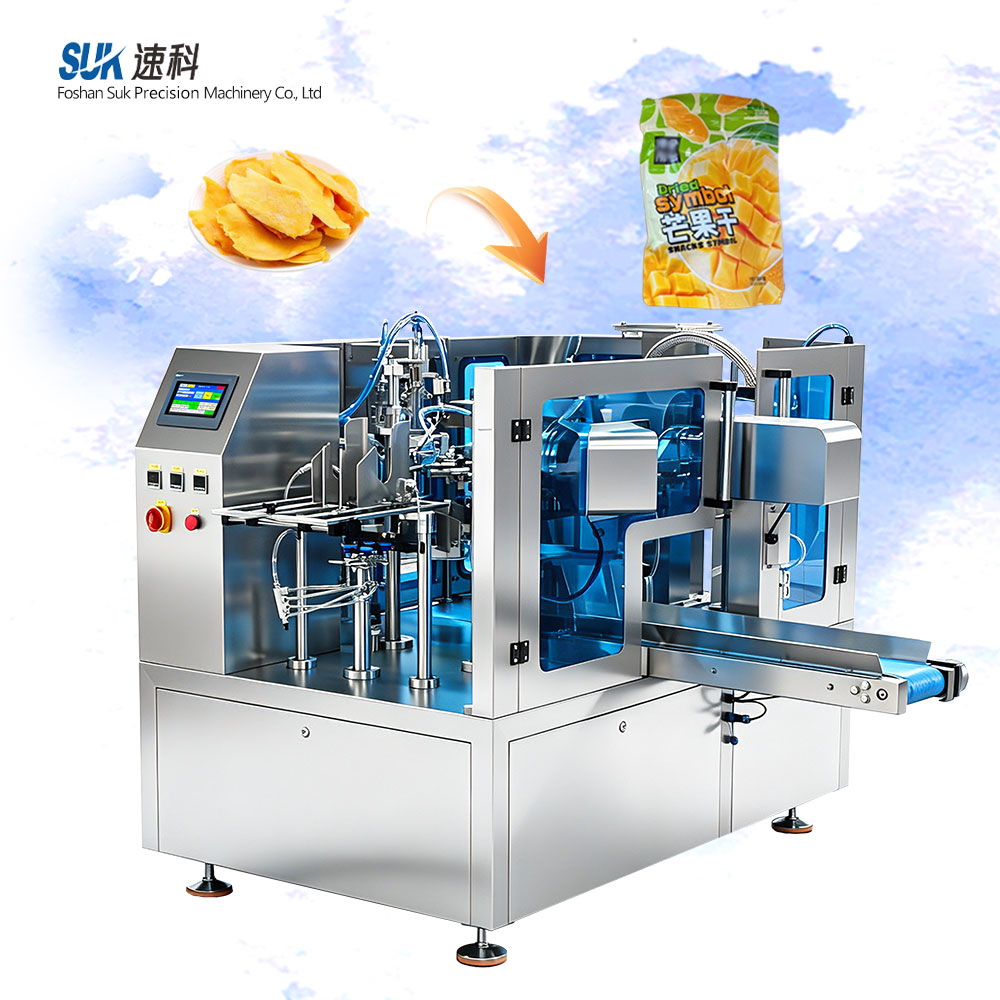
A coffee bean packaging machine should be selected by the finished bag format and target net weight—not simply by the word “coffee.” SUK's current catalog provides two routes to compare: premade-pouch machines for ready-made pouches, and vertical form-fill-seal (VFFS) machines that form bags from roll film. The listed SKGD-200R and SKGD-300R premade-pouch models have maximum package weights of 2,500 g and 3,500 g. For larger target weights, review the catalog-listed SKL VFFS range and confirm the actual fill weight with your coffee beans.
This guide compares the two routes, summarizes the catalog specifications, and lists the information a factory should prepare before requesting a quotation. Because the VFFS catalog records capacity in millilitres, the approximate gram equivalents shown here use the buyer-provided planning assumption of 1 ml ≈ 1 g; bean bulk density varies, so a product test is required before treating that conversion as a net-weight specification.
Start with the target weight and bag format
Before comparing machine models, define the smallest and largest coffee pack you plan to run. A factory packing 250 g retail pouches has a different package-volume and presentation requirement from a roaster filling 1 kg bags or a food-service supplier filling 5 kg or 8 kg bags. If the same line must handle multiple SKUs, list every target weight, the expected production mix and how often operators will change formats.
Then identify how each finished bag will be supplied. With a premade pouch, the bag is manufactured and printed before it reaches the packaging line. The packaging machine handles the supplied bag through the configured process. With VFFS, the machine starts with roll film, forms the bag, fills it and seals it. These processes produce different package constructions and require different machine arrangements; they should not be presented as interchangeable without explaining the format difference.
For coffee, also record whether you are packing whole roasted beans, ground coffee, or both. This article focuses on whole beans. Bean size, roast profile and bulk density affect the volume occupied by a given net weight. A product photo is useful for an initial discussion, but a representative bean sample and actual bag drawing are more useful for confirming the machine route and pack configuration.
Premade pouch packaging for ready-made coffee bags
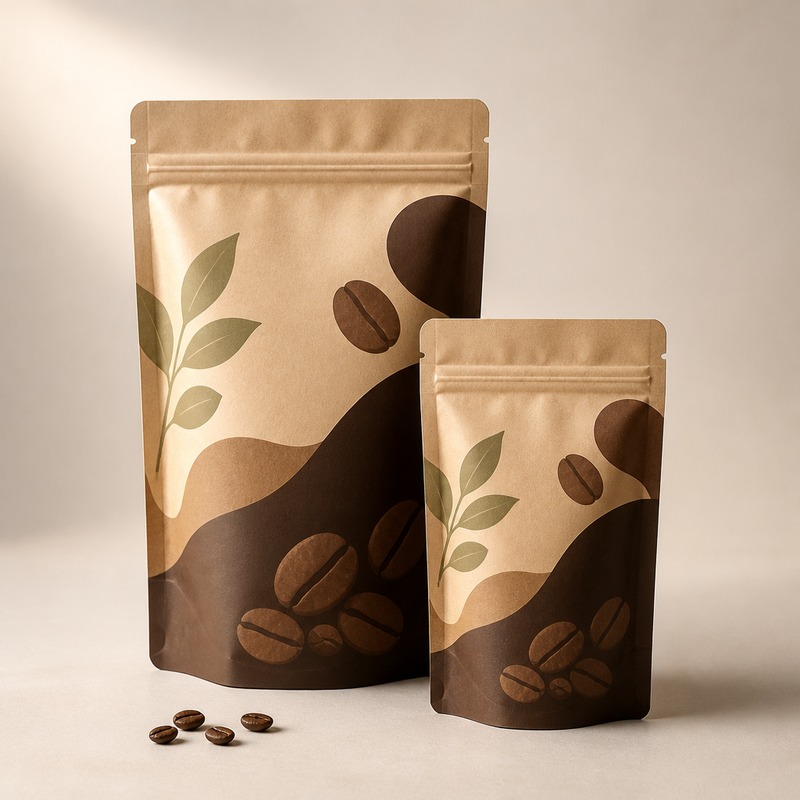
A premade-pouch coffee bean packaging machine is a route to assess when your factory already purchases finished bags, such as compatible stand-up pouches or other ready-made formats. The machine is configured around the bag dimensions, opening behavior, seal structure and product filling requirements. The pouch may be pre-printed with the coffee brand artwork before it reaches the machine, which is one reason factories often consider this route for retail packs.
SUK's coffee premade-pouch product information lists two models. The SKGD-200R has a stated package range of 10–2,500 g, while the SKGD-300R has a stated package range of 10–3,500 g. The catalog also lists different bag dimensions and speeds for the two models. These are model specifications, not a guarantee that any bag construction or bean sample will run at the stated maximum speed. Bag stiffness, opening behavior, product volume, weighing arrangement and the required seal all need to be checked.
A factory considering a 1 kg pack may compare premade-pouch and VFFS options depending on whether its preferred bag is bought ready-made or formed from roll film. If the target is above 3,500 g, the stated SKGD package range does not cover it; review the applicable VFFS model instead. Do not select a premade-pouch model for an 8 kg target based solely on a similar-looking pouch image. Confirm the specification and process with the actual package and bean sample.
VFFS packaging for roll-film bags and larger targets
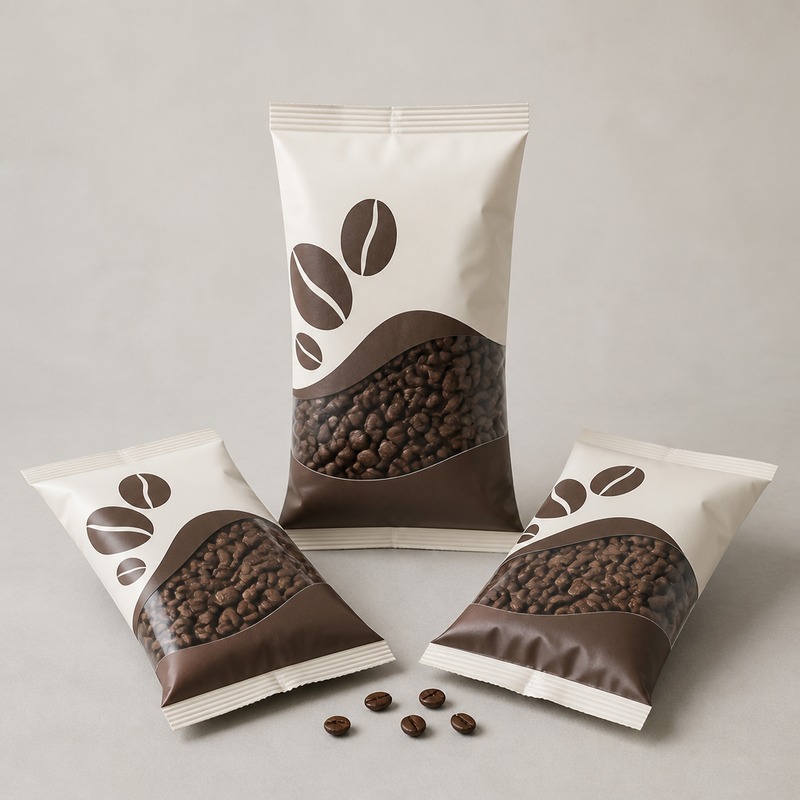
A vertical form-fill-seal machine forms a bag from a roll of film, fills the bag and seals it. This route can be relevant to factories that want to run roll-film bags and to projects where a larger fill target is beyond the stated SKGD premade-pouch range. The correct SKL model depends on required fill volume, bag dimensions, desired output, film characteristics and the actual beans.
The supplied SUK catalog lists SKL-820 with a measuring range of 1,000–6,000 ml and SKL-1020 with 2,000–10,000 ml. Their listed bag dimensions and speeds differ. For this project, SUK has specified a preliminary planning equivalence of 1 ml ≈ 1 g. Under that assumption, SKL-820 is approximately 1–6 kg and SKL-1020 approximately 2–10 kg. This is not a universal physical conversion for coffee beans: the mass contained in a volume depends on the sample's bulk density and how it settles. Verify the actual net weight through a machine test using the customer's coffee beans.
The two model ranges overlap. That overlap is helpful for a factory comparing different bag sizes or production goals, but it does not mean the models are identical or that either should be selected without review. Compare bag width, bag length, speed, voltage, available floor space and line integration. A complete inquiry should state the destination electrical supply so the listed power and voltage can be checked against the installation site.
Compare the listed SUK models
The following values are transcribed from SUK's catalog/product information for the relevant coffee premade-pouch machines and SKL VFFS models. The catalog records SKL measuring range in ml. Approximate kg values in the table apply only to the customer-provided preliminary planning assumption of 1 ml ≈ 1 g; actual coffee bean net weight must be confirmed by a product test.
| Route | Model | Measuring/package range | Approx. planning equivalent | Bag length | Bag width | Speed | Power | Voltage |
|---|---|---|---|---|---|---|---|---|
| Premade pouch | SKGD-200R | 10–2,500 g | 10 g–2.5 kg | 100–350 mm | 80–200 mm | 20–60 bags/min | 3.5 kW | 380 V, 50 Hz |
| Premade pouch | SKGD-300R | 10–3,500 g | 10 g–3.5 kg | 100–400 mm | 180–300 mm | 20–45 bags/min | 5.5 kW | 380 V, 50 Hz |
| VFFS, roll film | SKL-820 | 1,000–6,000 ml | approx. 1–6 kg* | 80–500 mm | 300–820 mm | 10–40 bags/min | 5 kW | 220 V, 50/60 Hz |
| VFFS, roll film | SKL-1020 | 2,000–10,000 ml | approx. 2–10 kg* | 120–600 mm | 520–1,020 mm | 8–30 bags/min | 3.2 kW | 380 V, 50/60 Hz |
*Approximate project planning only using 1 ml ≈ 1 g as specified by the buyer. Whole-bean bulk density and settling affect the actual mass; confirm using the intended coffee and bag. Model suitability, achievable speed and final bag dimensions require technical review.
Use the table to shortlist models, not to bypass a test. The final quotation should state the bean sample, target net weight, chosen bag style, actual bag dimensions, desired output and destination power requirement. Ask the supplier to confirm which measurement and dosing arrangement will be configured for whole beans.
How whole coffee beans affect the packaging process
Whole roasted beans are not uniform spheres. Bean size and shape vary by coffee origin, screen size, roast profile and processing. These characteristics influence how the beans occupy space in the bag and how they settle during filling. A nominally identical volume can therefore hold different net weights across different bean samples or operating conditions.
For that reason, separate volume capacity from verified net weight in the project brief. The catalog lists volume ranges for the SKL models, while the requested 1 ml ≈ 1 g equivalence is a preliminary planning convention for this selection exercise. It helps identify which models to review for target packs; it does not remove the need to weigh real filled bags. If a factory needs a specific net-weight tolerance, state it and confirm the dosing and checking process with SUK engineering.
Also discuss product handling and the required pack presentation. The factory may have constraints around loose beans in the seal area, package stability, bag dimensions or conveyor handling. These details should be assessed with the actual packaging material and sample rather than assumed from generic coffee pictures. Any optional package feature, such as a valve or a special closure, should be specified and confirmed separately; do not assume a machine includes it unless it is listed in the confirmed configuration.
Decide between premade pouches and VFFS
The decision can be framed around four questions. First, are the bags purchased ready-made or formed from roll film? Second, what are the smallest and largest target net weights? Third, what bag dimensions and finished presentation does the coffee brand require? Fourth, what speed and line configuration does the factory need?
A premade-pouch route is the logical comparison when the coffee brand has ready-made bags and the target falls within the SKGD model's stated range. A VFFS route is the comparison when the factory wants to form bags from roll film or when the target exceeds the selected premade-pouch model's listed maximum. A project around 1 kg may require comparing both processes: the final decision depends on the bag type, supplier model range and project requirements. Larger 5–8 kg targets should be checked against the applicable SKL measurement range, bag size and test results.
The output target is another key differentiator. The catalog lists speeds for each model, but real performance can depend on bean characteristics, bag size, weighing method, film behavior, operator setup and line integration. If the line will run several coffee SKUs, evaluate changeover time and the package range alongside nominal bags per minute. A machine that meets the maximum theoretical speed but cannot reliably handle the customer's preferred bag or bean sample may not be the best fit.
Prepare a complete factory quotation brief
A clear project brief helps the supplier assess the machine route rather than guess from a single product keyword. Include representative whole roasted beans; every target net weight; bag length and width; bag style; roll-film or premade-bag supply; material information if known; required bags per minute; hours per shift; destination voltage and frequency; available floor space; and any downstream equipment requirements.
If you already use a packaging line, share the current pack and describe the production issue you want to solve. It may be a target-weight limitation, inconsistent bag appearance, frequent format changes, a need for higher output or a line-layout constraint. If this is a new factory line, provide the available floor plan and preferred product-flow direction. Add a short video of the bean feed and current packing process if available, but do not send confidential customer materials or proprietary designs without permission.
SUK can use this information to compare the SKGD premade-pouch route with the SKL VFFS route and identify which model range merits a sample test. Ask for confirmation of the proposed bag dimensions, measurement range, electrical requirements and target output in the written quotation. This makes the comparison useful for purchasing, engineering and production teams.
Frequently asked questions
Which machine should I use for 1 kg coffee bean bags?
A 1 kg target is within the stated SKGD package ranges and also overlaps the SKL-820 catalog measuring range when using the project's preliminary 1 ml ≈ 1 g assumption. Compare ready-made pouch versus roll-film bag requirements, bag dimensions, speed and project layout, then validate the target with the actual beans.
Can SKGD-200R or SKGD-300R package 5 kg or 8 kg?
The listed maximum package weights are 2,500 g for SKGD-200R and 3,500 g for SKGD-300R. Those listed ranges do not cover a 5 kg or 8 kg target. Review the VFFS SKL range and confirm the actual application with a product test.
Which VFFS models are listed for larger coffee packs?
The supplied catalog lists SKL-820 at 1,000–6,000 ml and SKL-1020 at 2,000–10,000 ml. Their listed bag dimensions, speed, power and voltage differ. The appropriate model depends on the target pack and must be checked against the coffee sample and bag requirements.
Does 1 ml equal 1 g for every coffee bean?
No. The equivalence of 1 ml ≈ 1 g is a preliminary planning assumption specified for this project. Whole-bean bulk density varies, so actual filled mass must be checked by testing the intended coffee beans.
What is the difference between a coffee VFFS machine and a premade-pouch machine?
A VFFS machine forms bags from roll film before filling and sealing. A premade-pouch machine starts with ready-made bags and handles them through the configured process. The best route depends on the desired finished bag and how the factory supplies its packaging material.
What information should I send to request a coffee packaging machine quotation?
Send a representative bean sample, target weights, bag sample or drawing, roll-film or premade-pouch preference, required output, destination voltage/frequency, installation space and any downstream line requirements. State any requested package feature explicitly for technical confirmation.
Request a coffee bean packaging machine review
Send your whole coffee beans, target net weights, pouch sample or roll-film bag drawing, required production speed and destination electrical supply to SUK Precision Machinery. Tell us whether you plan to use ready-made pouches or form bags from roll film. SUK can then compare the catalog-listed SKGD and SKL ranges and advise which configuration should be validated with your product.
For a useful review, include the smallest and largest pack sizes, the bean sample, bag dimensions, film or pouch construction if known, expected bags per minute and the voltage available at the installation site. If the product is intended for 5 kg or 8 kg bags, say so at the start of the inquiry so the technical team can focus on the appropriate VFFS range rather than the smaller premade-pouch models.
For readers comparing the two routes, continue to the coffee bean premade pouch packaging machine page for ready-made bag handling, or the coffee bean packaging machine overview for the SKGD and SKL route comparison. The vertical weighing and packaging machine page can support roll-film projects once its model details are aligned with the current catalog. These links help a buyer move from general selection criteria to the relevant machine information without treating every coffee pack as the same application.