Start with the honey product and serving format
A honey sachet packing machine should be chosen from the actual honey product, portion volume, sachet format and factory workflow. Honey can differ in viscosity, temperature, formula and flow behavior, so a general request for a “honey machine” is not enough to define the filling system. A food factory should first decide whether it needs narrow stick packs, flat sachets, round-corner packs or another single-serve liquid format.
The serving environment also matters. Hotel breakfast portions, cafés, restaurants, catering packs, airline service and retail trial sachets may require different dimensions, opening features and film structures. A good project brief states the intended market, target fill volume, preferred sachet length and width, expected production and downstream handling.
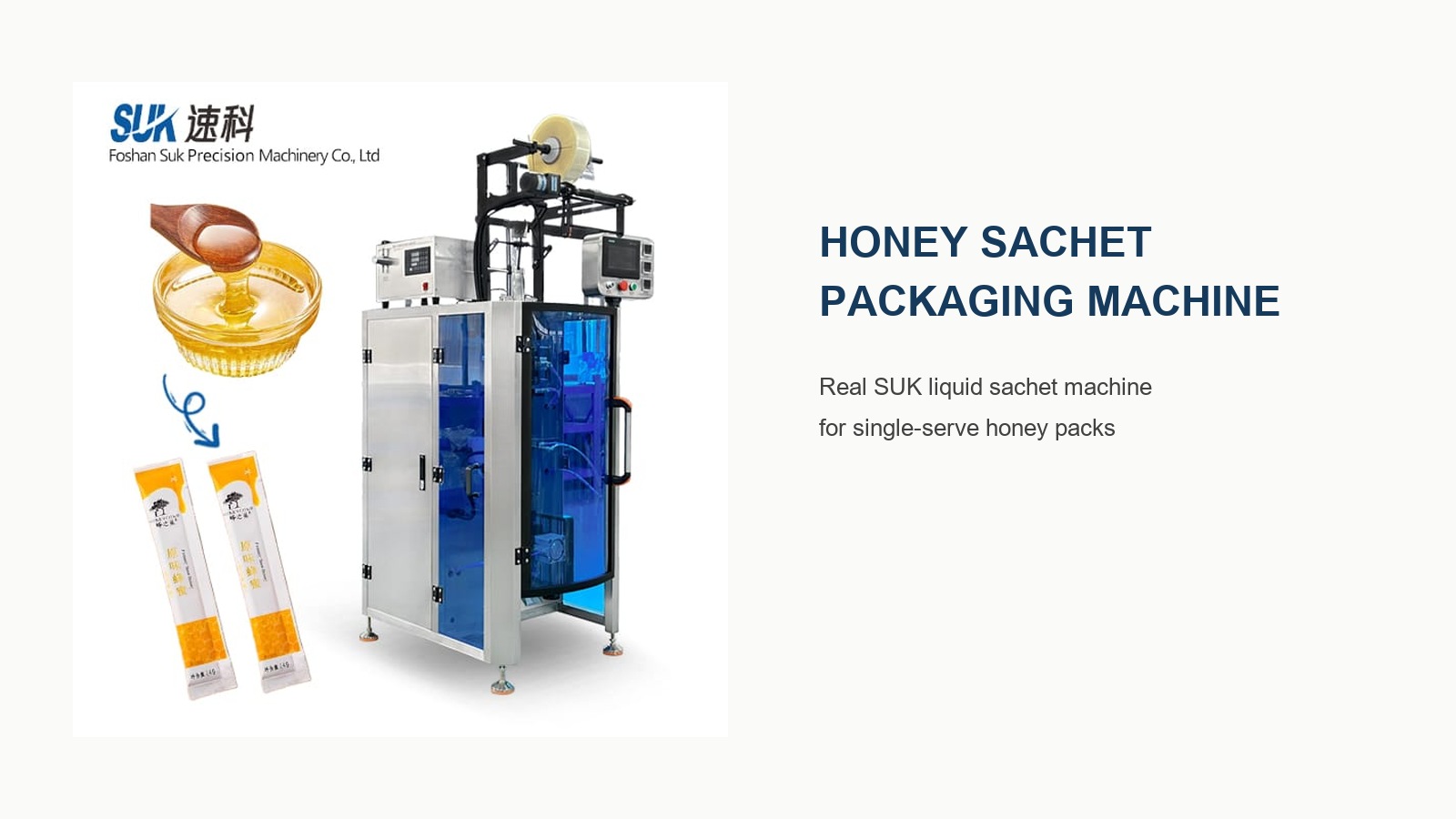
SUK’s Honey Sachet Packing Machine page is the product-level destination for this type of project. It describes the SKTB-120QY liquid sachet platform and the project information needed before a quotation.
What is a honey sachet packing machine?
A liquid sachet packing machine forms small packs from roll film, meters the liquid product, fills the sachet, seals the film and cuts the finished portions. For honey, the machine must be reviewed around the real product temperature, viscosity, target volume, pump or filling method, film and seal area.
The finished package may be a narrow honey stick pack or another small liquid sachet. A narrow pack can be useful for single-use service because the user can open one portion without handling a larger jar or bottle. The pack length, width, cut shape and seal layout should be confirmed with the product and the expected opening experience.
The machine does not automatically determine the package design. The customer’s film artwork, roll dimensions, seal structure and cut tool are part of the project specification. The best starting point is a honey sample plus a drawing or physical sample of the desired finished sachet.
How honey filling differs from powder filling
Honey is a liquid with viscosity and flow behavior that differ from powder. A powder sachet machine normally focuses on powder dosing, dust control and film sealing around a dry product. A honey project focuses on liquid transfer, pump selection, filling timing, product temperature, seal cleanliness and cleaning access.
If honey reaches the seal area, the seal can be affected. The filling system and film path should therefore be assessed together. The factory should also explain whether the line will run one honey formula or several syrups and liquid products, because product changeover and cleaning can influence the practical production schedule.
This is why a honey sachet machine should not inherit the parameters of a powder stick machine or a multi-lane powder machine. The product form is different, the filling method may be different, and the finished sachet needs its own test. A honey sample is more valuable than a generic product label when the configuration is reviewed.
Choose the finished honey sachet format
A honey stick pack is usually narrow and elongated, while a small liquid sachet may use another width, length or seal arrangement. The desired format can include back seal, three-side seal, four-side seal, flat cut, serrated cut, round-corner cut or another shape when supported by the selected configuration.
The customer should provide the target format before asking for a final recommendation. Include the pack width, pack length, fill volume, tear feature, seal area and whether the sachets will be counted, bundled, boxed or placed directly into food-service distribution. If the pack will be opened by hand at a hotel or café, the tear experience is an important part of the product brief.
Do not describe a honey sachet machine as a premade pouch machine. A premade pouch system starts with ready-made stand-up or zipper pouches. A liquid sachet machine forms small portions from roll film as part of its packaging process. The two routes have different film supply and package-production logic.
SKTB-120QY catalog specifications
The 2026 SUK catalog, page 16, identifies the SKTB-120QY as a Liquid Sachet Packing Machine. The following values are transcribed from the visible catalog parameter table; the final configuration should be confirmed against the actual honey sample and film.
| Model | SKTB-120QY |
| Speed | 30–60 bags/min |
| Bag size | Length 40–170 mm; width 20–50 mm |
| Applicable film thickness | 0.08–0.12 mm |
| Maximum roll-film diameter | 320 mm |
| Power | 2000 W |
| Packaging material | Aluminium composite film, OPP composite film, CPP composite film; examples BOPP/PE, PET/PE and PET/AL |
| Noise | ≤80 dB |
| Measurement range | 5–20 ml |
| Machine dimension | L 1000 × W 890 × H 1820 mm |
| Machine weight | 200 kg |
The table is a product-platform reference, not a guarantee that every honey formula will run at the same result. Confirm the filling method, temperature, viscosity, film, seal and cut requirements through project review and testing.
Review the liquid filling and sealing process
Before selecting the machine, describe how the honey behaves at the intended filling temperature. Include viscosity information if available, whether the product crystallizes or contains particles, and whether the formula includes other syrup or flavor components. These details help the engineering team assess the product-contact path and filling method.
The film must also be compatible with the product and sealing process. Provide the film structure, thickness, roll information and any existing pouch sample. If the project needs a specific tear notch, rounded corner or shaped cut, identify it in the drawing rather than assuming that a general machine photograph represents the final pack.
A useful factory test should observe filling consistency, seal cleanliness, cut quality, leakage risk, product residue, changeover and cleaning. The test should use the customer’s honey and target film wherever possible. If a customer uses several honey blends, compare the easiest and most difficult formulas rather than testing only one convenient sample. Record the selected fill volume, film structure, sealing condition and cut style so the final quotation remains connected to the tested package.
Plan the line after the sachet machine
Honey sachets may leave the machine as individual packs, connected strips or grouped portions depending on the confirmed configuration. The next operation may include counting, accumulation, boxing, cartoning, case packing or manual inspection. The downstream process should be discussed before the machine layout is finalized.
If the product is supplied to hotels or catering customers, the factory may need a counting and bundling step. If it is sold in retail or promotional packs, a carton or display package may be required. The sachet machine should connect cleanly to the planned downstream workflow, with space for inspection and cleaning access.
SUK can also discuss related cartoning and packaging-line equipment when the project includes secondary packaging. The final line should be based on the actual sachet size, output requirement and customer packing method. Include the operator workflow, inspection position, accumulation space and cleaning access in the layout discussion. A small honey sachet may be easy to produce but still require careful counting and handling after discharge, especially when the packs are bundled for food-service customers.
What information should you send for a quotation?
Prepare the following information before contacting a honey sachet machine supplier:
- Honey formula and product sample
- Target fill volume in millilitres
- Viscosity and intended filling temperature
- Sachet or stick-pack length and width
- Film structure, thickness and roll information
- Required seal and cut style
- Target bags per minute and daily production
- Number of formulas or SKUs and changeover frequency
- Destination country and electrical standard
- Date coding, inspection, counting, bundling or cartoning requirements
- Existing pack sample, artwork or dimensional drawing
This information prevents the project from being evaluated from a generic image alone. It also lets the supplier distinguish between a honey stick pack, liquid sachet, premade pouch and another packaging route. If the factory is replacing an existing line, include the current pack and the main production problem. If it is a new line, include the expected launch volumes and serving market.
FAQ
Can honey be packed in stick packs?
Yes, honey can be evaluated for single-serve stick-pack packaging. The suitable filling method, film, seal and cut style depend on the actual honey formula, viscosity, fill volume and target pack.
What is the difference between a honey sachet and a honey stick pack?
Both are small single-serve liquid packages, but the width, length, seal arrangement and cut shape may differ. Confirm the desired finished format with a drawing or sample before selecting the configuration.
Can the machine make round-corner honey packs?
The relevant SUK liquid-stick product information lists round-corner cutting as an available cut type for the applicable configuration. The final tool, film and dimensions must be confirmed for the customer’s project.
What is the SKTB-120QY speed?
The 2026 SUK catalog lists 30–60 bags per minute for the SKTB-120QY. Actual output depends on honey properties, fill volume, pack size, film, sealing, cutting and operating conditions.
What film materials are listed for the machine?
The catalog lists aluminium composite film, OPP composite film and CPP composite film, with examples including BOPP/PE, PET/PE and PET/AL. The final film must be checked for the actual product and sealing process.
Request a honey sachet machine review
Send the honey sample, target fill volume, sachet dimensions and film information to SUK Precision Machinery. SUK can review the liquid product and target pack, then assess whether the SKTB-120QY platform and related equipment fit the factory project. Include your destination market, electrical standard, daily output, desired cut style and any counting or cartoning requirement. This gives the team enough context to separate a simple single-serve honey project from a larger food-service packaging line.
For the first technical discussion, also include a photo of the current package if one already exists, the expected number of honey products, and whether the machine will be installed in an existing line or a new production area. These details help the team review material flow, operator access and the likely downstream arrangement before formal quotation. If the package must enter a carton or bundle, include the carton drawing as well.
Related SUK pages
The Honey Sachet Packing Machine page is the main conversion destination for this article. The liquid stick-pack page provides a broader package-format reference, while the general Stick Packing Machine page covers mixed powder, granule, liquid and gel applications. If the honey project requires secondary cartons, connect the sachet output to the Automatic Cartoning Machine page. These links keep the article focused on honey while allowing a buyer to compare the correct machine family and downstream route.
Use the related pages by intent: start with the honey page when the product is honey and the pack is a liquid sachet; compare the round-corner liquid page when the visual cut shape is important; review the general stick page when the factory is also considering powder or granule products; and move to cartoning when the sachets need to be counted and placed into retail or food-service cartons. This prevents the article from sending every visitor to a generic product page.